
NFPA 13D Residential Systems
NFPA 13D is the fire sprinkler code for homes. It governs the design, installation, and testing of fire sprinkler systems in one- and two-family dwellings — single-family homes, duplexes, and townhomes up to four stories.
Washington state requires NFPA 13D systems in all new residential construction.Rain City Fire Protection designs and installs these systems across Seattle and the Eastside. Here’s what you need to know about the code and how it applies to your home.
What Is NFPA 13D?
NFPA 13D is a standard published by the National Fire Protection Association. It provides the minimum requirements for designing and installing fire sprinkler systems in one- and two-family dwellings and manufactured homes. Think of it as the rulebook for residential fire sprinklers.
The standard covers everything: water supply requirements, pipe sizing, head placement and spacing, system testing, and maintenance. It’s specifically written for homes — simpler and more cost-effective than the commercial codes (NFPA 13 and 13R) because residential fire risks and building construction are different from commercial buildings.
In Washington state, the residential building code adopts NFPA 13D as the governing standard for fire sprinkler systems in new homes. Local jurisdictions — Seattle, Bellevue, Kirkland, and others — may add amendments on top of the base code.
NFPA 13D vs. 13R vs. 13
Three different codes for three different building types.
NFPA 13D
- Scope
- One- and two-family dwellings and manufactured homes
- Building Types
- Single-family homes, duplexes, townhomes (up to 4 stories)
- Water Supply
- Domestic water supply (city water or well)
- Design Intent
- Designed for life safety — sprinklers in living spaces
NFPA 13R
- Scope
- Residential occupancies up to 4 stories
- Building Types
- Apartments, condos, hotels, dormitories
- Water Supply
- Dedicated fire water supply or boosted domestic
- Design Intent
- Designed for life safety with some property protection
NFPA 13
- Scope
- All occupancy types
- Building Types
- Commercial, industrial, high-rise, large multifamily
- Water Supply
- Dedicated fire water supply, often with fire pump
- Design Intent
- Designed for full property and life safety protection
Key Requirements
The main things NFPA 13D governs in your home's sprinkler system.
Water Supply
NFPA 13D systems are designed to operate off your domestic water supply — the same city water line that feeds your home. We test the flow rate and pressure at your property to make sure it can support the system without a booster pump.
Head Spacing & Coverage
NFPA 13D specifies maximum coverage areas and spacing for each sprinkler head based on the room type and ceiling height. Heads are required in all living spaces, closets over a certain size, and attached garages. Bathrooms under 55 sq ft and small closets may be exempt.
Pipe Sizing
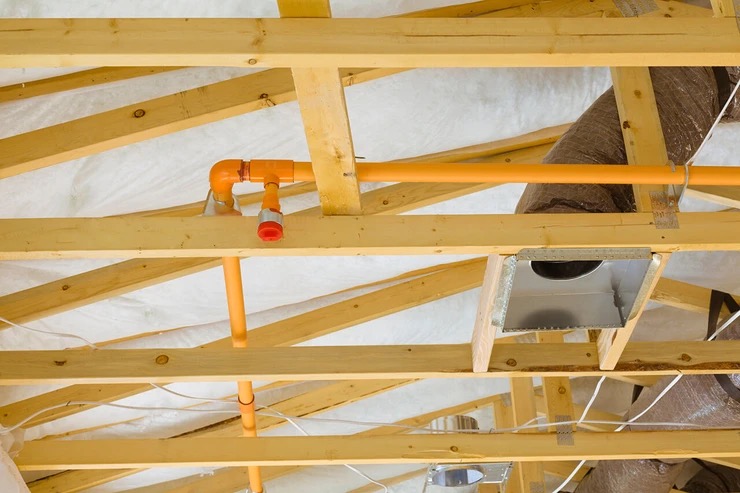
Pipe diameters are calculated hydraulically to deliver the required water flow to the most demanding heads in the system. CPVC is the standard pipe material for residential work — lightweight, corrosion-resistant, and cost-effective.
Coverage Areas
NFPA 13D requires sprinkler coverage in all habitable rooms, hallways, closets (over 24 sq ft), and attached garages. Some areas like attics, crawl spaces, and small bathrooms are typically exempt — but local jurisdictions may add requirements.
Why NFPA 13D Matters for Your Home
Residential fire sprinklers save lives. According to the NFPA, homes with fire sprinklers have an 81% lower death rate from fire compared to homes without them. The water damage from a sprinkler activation is a fraction of what a fire department’s hose lines would cause.
NFPA 13D systems are designed specifically for homes — they’re simpler, less expensive, and less intrusive than commercial systems. They use your existing water supply, CPVC pipe that fits in standard wall cavities, and concealed heads that blend with your ceiling.
In Washington state, this isn’t optional for new construction. But even setting the code requirement aside, an NFPA 13D system is a practical investment in your family’s safety and your home’s protection.
Frequently Asked Questions
In Washington state, fire sprinklers are required in all new one- and two-family dwellings and townhomes under the residential building code. If you're building a new home in Seattle or the surrounding cities, you need an NFPA 13D system. Existing homes are generally exempt unless undergoing a major renovation that triggers the requirement.
NFPA 13D is the residential code — designed for homes, using domestic water supply, with coverage focused on living spaces. NFPA 13 is the commercial code — designed for all building types, requiring dedicated fire water supply and full-building coverage. Residential systems are simpler, less expensive, and designed specifically for the fire risks found in homes.
NFPA 13D allows exemptions for certain areas: bathrooms under 55 square feet, small closets under 24 square feet, attics without storage, and open covered porches. However, local jurisdictions can add requirements beyond the base code, so the exact exemptions depend on where your home is being built.
Yes — that's one of the key features of NFPA 13D. The system connects to your domestic water line, the same supply that feeds your faucets and showers. We test the flow and pressure at your property during the design phase to confirm it's adequate. In most Seattle metro areas, the municipal water supply is sufficient.
For a typical single-family home, a complete NFPA 13D system — design, permitting, installation, and inspection — typically runs $1.50 to $3.00 per square foot. The exact cost depends on the home's size, layout, number of stories, and water supply conditions. We provide detailed quotes based on your specific floor plans.
Related Services
Need an NFPA 13D system for your new home?
Send us your floor plans and we'll scope the project and get you a quote.